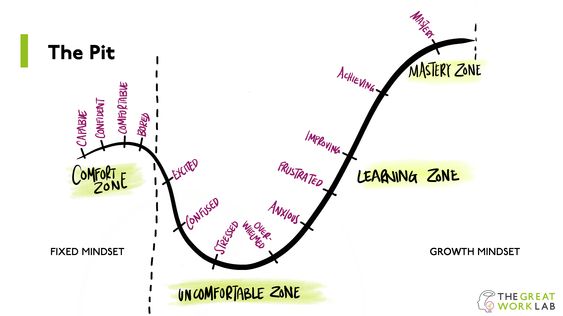
Over the past 18 months, I’ve had many conversations about the long game, endurance, and learning pits. And how translating these into coherent actions, it is hard work. Very hard work. But if you do so for long enough, eventually, you reach a magical turning point. Suddenly, the work and pain becomes valuable. Worth something (literally and figuratively). The value of hard work is achieved.
But herein lies the conundrum so many face: how does one reasonably apply this effort (playing the long game; enduring mental & emotional work; and dipping in and out of learning pits), sustainably? How do you sustain the discomfort of hard work without burnout? Long enough for it to turn into something valuable…
Unpopular Opinions re: the Value of Hard Work
You’ve heard me say: I enjoy working. I hold dear the power to make money and control my own destiny, while helping others – both inside and outside my organization. It’s a big responsibility that I take very seriously. Also, I like being useful, and I have have fun when I’m solving new, interesting problems. And lucky me: my job includes all these aspects. Thus, I love working. It doesn’t mean it comes easy to me, and it doesn’t mean that I love every part of it. A lot of what I do is very hard work. But I’ve figured out how to package it all up so that it’s valuable. Which brings me to unpopular opinion #1…
1. It Takes (a lot of) Hard Work before It’s Easy.
Care of our beloved Hola Yoga, I recently read Scott Galloway’s Algebra of Wealth. (You want to hear some unpopular opinions… listen to him speak). In this book, he said the most fantastic thing about “finding your passion.”
Don’t Follow Your Passion
If someone tells you to follow your passion, it means they’re already rich. And typically, they made their fortune in some unglamorous industry like iron ore smelting. Your mission is to find something you’re good at and apply the thousands of hours of grit and sacrifice necessary to become great at it. As you get there, the feeling of growth and your increasing mastery of your craft, along with the economic rewards, recognition, and camraderie, will make you passionate about whatever ‘it’ is.
There’s no ease without effort. This is realizing the value of hard work.
2. A CEO’s Job Is More than: Vision & Strategize.
A CEO’s job is just that… a job. Done well, it’s hard, hard work. And more importantly, it holds a tremendous weight of responsibility – whether you’re the CEO of a Fortune 500 company, or one of our Small Business CEOs. When Ellevated Outcomes speaks of the CEO Mindset and being “on” your business, it’s not a sit-on-the-beach-watching-everyone-else-work position. It take a lot of “worm work,” organization, and discipline to eventually pull yourself above the day-to-day activity so that you can do the thrive, survive, or die work of managing your business.
3. There ARE Enough Hours in the Day.
Some people will hate me for this statement: I fundamentally believe there are exactly the right number of hours in a day. The problem isn’t time. The problem is that most people haven’t honed the skill of prioritizing and discipline of saying “no” or “not right now” to use their time well. This opinion was born from a quote I read >25 years ago. Since reading it, I’ve used it as a guiding principle for how I run my life and my business:
Everything changed the day she figured out there was exactly enough time for the important things in her life.
How to Avoid Burnout while Attaining the Value of Hard Work
So if you’re willing to humor my opinions, here are my 5 tips to avoid burnout while working hard.
1. Pick Your Spots. (Only 3).
You cannot strive for more than 3 things at any time – across both life and work. This isn’t magic, convenience, or mindset. It’s discipline. You must pick your spots. The good news is: these can change. They should change, as you move through different life and career stages.
For me, the reason my career is what it is, is because for the past 20 years, it’s remained in my top 3. I’m not saying that should be true for everyone; but I’ve made a conscious decision to say no to other things so that this remains in my top 3. And I re-evaluate each year when I’m goal setting.
2. Define Complete.
I’ve mastered the art and science of diminishing turns. I think it comes from my lifelong study of European culture, combined with a career in strategy. In strategy, you want to find the lever of least effort that produces the maximum results.
It’s a skill (that anyone can learn): to pinpoint exactly what and how much you need, to declare success. You begin by answering “What does complete look like?”
For example, my priorities and goals are not open-ended, nebulous ideas. I’ve define “complete” so that I can declare success when I arrive, and reevaluate if I want to change out a priority. This stops me from living in endless scope creep and a bottomless to do list. Here was one year’s priority / objective list:
1. Career: I have been replaced as manager of Ellevated Outcomes’ Advisory Practice.
2. Home: Our house decor is complete with desired fixtures and fittings (8 defined projects are done).
3. Health: Replace 5 lbs fat with 5 lbs muscle.
When these are done, my hard work has done its job; and my to-do list is complete. Can you imagine!?
3. Trim Your Ambitions 20%.
Most people are awful project-managers-of-self. You’ve heard the adage: we overestimate what we can do in a day and underestimate what we can do in a year.
I learned this technique from a personal trainer: when you set goals and timelines, they’re likely too ambitious. To make something realistic and achievable, trim what you really want to do by 20%.
The first time I did this for Ellevated Outcomes was the first time we fully met our goal.
4. Manage your Calendar & Activities.
I talk about this so often that I won’t repeat. Here are my best practices for managing your calendar: analog and digital. The basics work, if you work the basics.
80% of your activities (across life and work) should directly support your 3 priorities. I can’t think of any exceptions.
5. Schedule Margin & Refuel Time.
When I talk about “hard work,” it has nothing to do with the quantity and everything to do with the quality. Looking back at my data for the past few years, I tend to work 34-37 hours a week, for 47 weeks (our team gets 5 weeks of vacation + 12 holidays). This includes the multiple roles I occupy on our org chart. But for those 34-37 hours, I am working all-in, hard.
I take care of my body, brain, and spirit in intentionally, so that when I’m working on my business or other life priorities, it’s at the highest quality.
And I expect the same of our team. After all, for a Strategist working optimally, only 50% of their time is “billable” or spent on client work (I know this is blowing the mind of any professional services firm who’s used to maxing out billable time with a 3-4x multiple). But this is the optimal mix to give them learning, margin, and refuel time; so we can keep our work and team at the highest caliber.
Build in time and space: literal, emotional, and to have yourself a great life.
I promise: if you integrate just one of these principles, your life will change. You’ll agree with me that there is just enough time for the important things. Because you’ve written your own definition of what the important things are. And you won’t get burned out in the process. Honest, know-thyself prioritization, effort, and disciplined action are the ingredients to realizing the value of hard work, from practice to sustainable payoff.